


Whale watching in San Diego, California, is possible nearly year-round due to the migratory patterns of different whale species. Seeing these fascinating creatures in their natural habitat is a one-of-a-kind experience that everyone should enjoy at least once.
The best way is by booking one of the many fun whale watching tours in San Diego. The tour operators I recommend (and that local concierge teams use) are experts on finding the best views of whales feeding, socializing, and playing. I will also cover the best times to go, what to bring whale watching, and where to possibly spot whales from the shore.
We can help you save on tickets, tours, and hotels. If you purchase through some of the links below, we may be compensated. Thank you for supporting our small business! Our editorial guidelines.
TIP
Look for San Diego whale watching tours with sighting guarantees. Many operators will take you out again for free if certain species of whales are not spotted during the trip.
Compare San Diego Whale Watching Tours at a Glance
Seven reputable operators run whale watching tours from different points along the San Diego coastline, including one kayak option. Here is how to choose based on where you are staying and what kind of experience you want. Detailed reviews of each operator follow below.
| Operator | Departs From | Best For |
|---|---|---|
| Flagship Cruises & Events | Downtown San Diego | Heritage and tradition, family-owned, longest-running whale watching operator in the world |
| City Experiences | Downtown San Diego | First-timers and motion-sensitive travelers, naturalist narration from the San Diego Natural History Museum |
| Next Level Sailing | Shelter Island | Sailing experience aboard the historic Yacht America, no-seasickness guarantee |
| San Diego Whale Watch | Mission Bay | Mission Bay and Pacific Beach lodging, year-round options including sunset cruises |
| Legacy Whale Watch | Mission Bay | Newer 80-foot boat, larger indoor seating, modern fleet |
| Everyday California | La Jolla | Kayak adventure during gray whale season (December to March), small group |
| O’side Whales | Oceanside Harbor | Carlsbad and North County lodging, intimate 6-passenger Zodiac, year-round, partner of The Seabird Resort |
Why Whale Watch in San Diego?
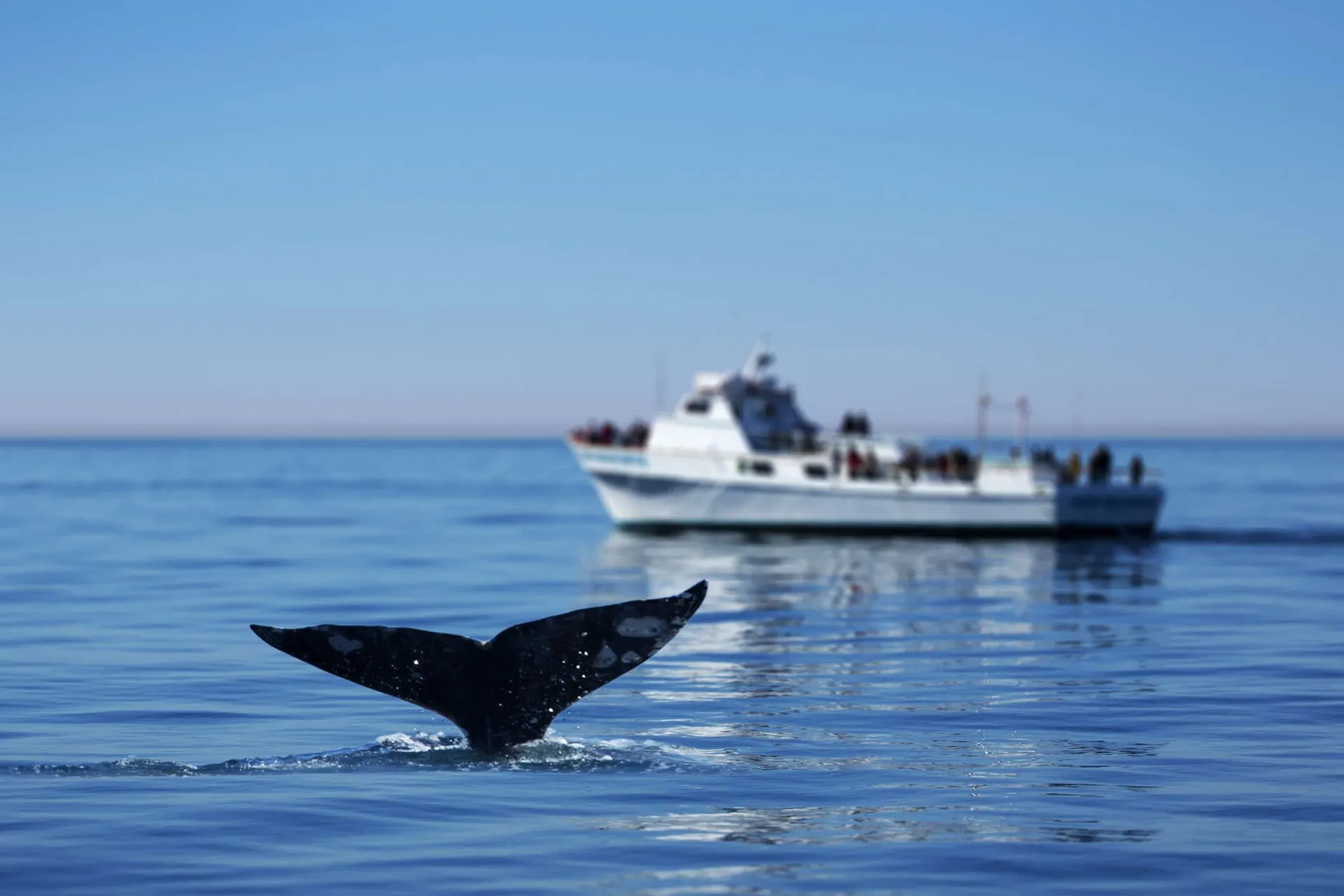
When booking San Diego tours or looking for things to do in San Diego with kids, be sure to include a whale-watching tour. It is one of our most popular outdoor activities, especially during the winter and early spring months.
San Diego’s 70 miles of coastline make it one of the best places to go whale watching in California. The region is home to one of the largest protected marine sanctuaries in Southern California, and the rich environment attracts a wide range of marine mammals. We sit along the migration path of several whale species you will want to see.
Gray whales migrate from Alaska to Baja California in the winter and spring, blue whales feed off the San Diego coast in summer, and other species like humpback whales, fin whales, minke whales, and pilot whales make appearances here, too.
On a typical whale watching cruise, you will usually see whales and dolphins. The dolphins include common dolphins, bottlenose dolphins, Risso dolphins, and Pacific white-sided dolphins.
The Best Time for Whale Watching in San Diego
The best time to take whale watching tours in San Diego is between mid-December and April during gray whale migration season, when over 20,000 gray whales travel from Alaska to warmer water in Baja California, Mexico, to give birth. This is not the only time to see whales here, though, and when to go depends on the species you most want to see. There are two main whale watching seasons.
During the winter and spring, thousands of gray whales travel 6,000 miles down the coastline on their way to Mexico’s warm calving grounds. If you are whale watching in late April or May, you might be lucky enough to spot moms with their calves.
In the summer and fall, the magnificent blue whale (the largest animal to have ever existed) passes by San Diego as part of the annual breeding and feeding migration. These large whales migrate further offshore, so you will need a cruise to see them.
Fin whales, only slightly smaller than blue whales, can be spotted near San Diego year-round, though you are more likely to encounter them November through March.
Friendly humpback whales can be seen off the coast of San Diego throughout the year. This species is popular with whale watchers for their famous breaching behavior.
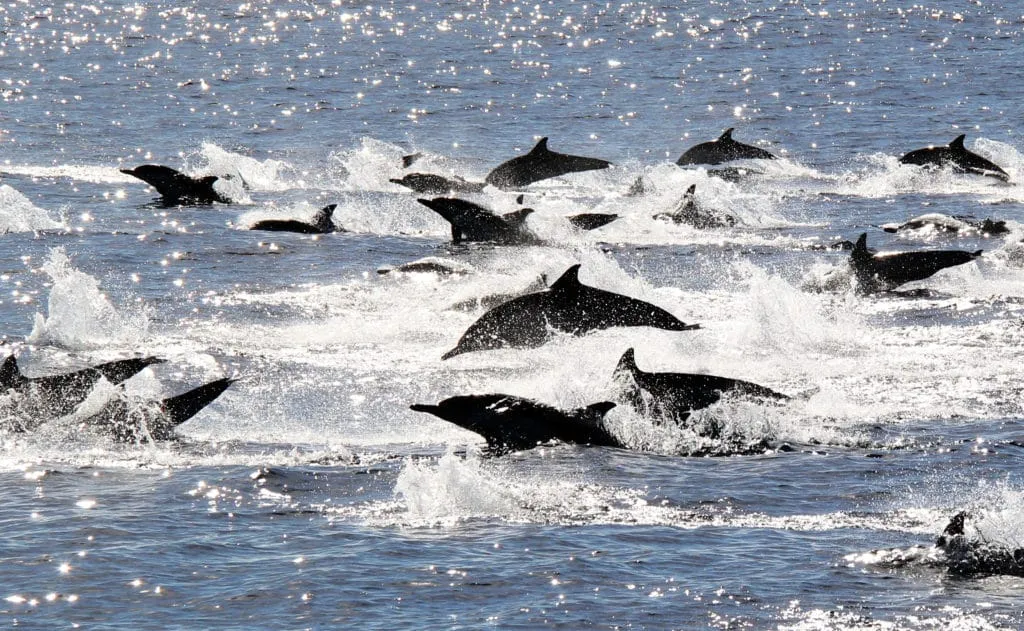
You will also spot dolphins, harbor seals, and California sea lions on most tours as you make your way in and out of the harbor. You might see a bonus orca or two, though those sightings are rare.
Weather can affect timing too. San Diego enjoys near year-round sunshine, and even a little rain may not impact your tour. Operators will cancel a tour if they deem conditions unsafe. The best time of day to go whale watching is in the morning, when the water is calmer and the light is better for spotting.
About the Gray Whale Migration
The annual gray whale migration is the longest of any mammal on Earth: roughly 10,000 miles round-trip from feeding grounds in the Arctic to breeding lagoons in Baja California, Mexico. San Diego sits squarely on the migration route, which is why from December through April you can see one of nature’s most impressive endurance journeys just offshore.
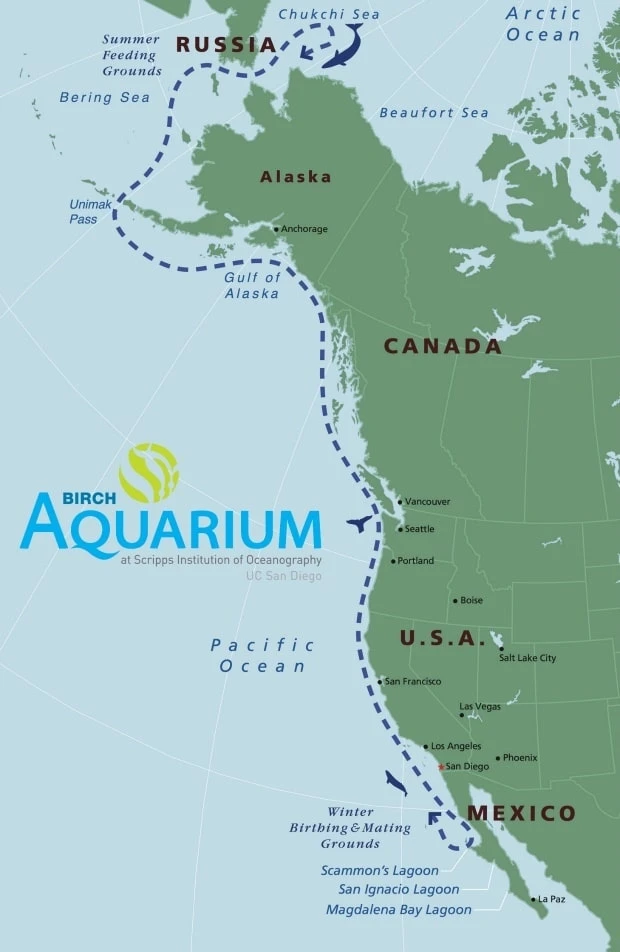
The first whales to head south are pregnant females and females ready to mate. They prefer the warm, shallow, predator-free lagoons of Baja for calving. By February the journey reverses, and by late spring, mothers and calves linger longest in the warm water before heading back north.
If you want to see gray whales from shore, January is the best month. As they head south to Baja, gray whales swim closer to the coastline. Heading back north later in the season they tend to swim further offshore, so spring shore viewing is much less reliable.
San Diego also has a small population of “rogue” gray whales (officially called the Pacific Coast feeding group) that skip the full migration and hang out between California and Canada through the summer. Roughly a few hundred individuals. They prefer not to commute, and honestly, who can blame them.
WOW YOUR KIDS
Gray whales can reach 50 feet long, are pregnant for 13.5 months, and have been observed snoring in the lagoons. Some scientists believe they sleep while migrating on autopilot, with their blowholes barely above water.
San Diego Whale Watching Tours: How to Choose
The side benefit of going whale watching in San Diego is the ancillary sightseeing along the way. You will sail along the San Diego Bay, pass Coronado or Point Loma, watch pelicans and gulls overhead, then continue to the Pacific Ocean. It can be a peaceful half-day on the water.
Make sure your tour departs from San Diego itself, since some Orange County tours (an hour or more away) market to San Diego visitors. Each operator below is well-rated and serves a different traveler. Pick based on where you are staying and the kind of experience you want.
Flagship Cruises & Events: Best for Heritage and Tradition
Departure location: Downtown San Diego (Broadway Pier)
Flagship Cruises & Events launched the world’s first commercial whale watching cruise in 1955 and is still family-owned. Their whale watching cruises run during the gray whale migration roughly between early December and mid-April aboard a spacious two-deck vessel.
A snack bar serves refreshments. The Whale Tail Guarantee means you can join another tour for free if you do not spot a whale during your trip. Flagship also operates the Coronado Ferry and other San Diego harbor cruises if you want to combine experiences.
City Experiences: Best for First-Timers and Naturalist Narration
Departure location: Downtown San Diego
Expert captains and naturalists from the San Diego Natural History Museum narrate winter gray whale and summer blue whale watching cruises. The yacht is considered one of the most comfortable in San Diego thanks to stabilizers that help prevent motion sickness, air-conditioned interiors, a fully stocked snack bar, and a full beverage bar. The boat also offers the largest open-air sun deck in San Diego.
Their Whale Check guarantee means that if you do not spot a whale, you can join another tour for free. Check out their whale watching cruises.
Next Level Sailing’s Yacht America: Best for Sailing Experience
Departure location: Shelter Island
Go gray whale or blue whale watching aboard the 139-foot Yacht America, a replica of the schooner that won the historic Royal Yacht Squadron’s 100 Guinea Cup race in 1851 (the race that became the America’s Cup). Water, soda, chips, and granola bars are provided, and you can bring your own food and drinks (no red wine).
Next Level Sailing offers what they describe as the only “no seasickness guarantee” in the world. Their historical rate is roughly one in 400 passengers, and affected guests get a small gift certificate. They also guarantee you will see a whale, or you can come back on another whale watching tour for free.
Everyday California: Best for Kayak Adventure During Gray Whale Season
Departure location: La Jolla (2261 Avenida de la Playa)
One of the best things to do in La Jolla is head out on a kayak tour of the San Diego-La Jolla Underwater Park. Between roughly December 1 and March 1 (depending on sightings), you can book a La Jolla whale watching kayak tour where guides take you about two miles offshore to spot gray whales. Group size is capped at around 20 for an intimate experience, and you may also see sea lions, dolphins, and harbor seals along the way.
Exclusive Everyday California Discount
Use code LJMOM20 for a 20% discount on kayak and snorkeling tours, lessons, and rentals.
San Diego Whale Watch: Best Mission Bay All-Rounder
Departure location: Mission Bay
San Diego Whale Watch operates The Privateer with various cruise options that depart year-round. Their Whale Guarantee means that if you do not see a dolphin or whale on your trip, your next trip is free. They offer 2- to 3-hour group cruises and sunset cruises, in addition to private outings. The boat has indoor seating and open viewing spaces on the upper and lower decks.
Legacy Whale Watch: Best Mission Bay Newer Boat
Departure location: Mission Bay
Legacy Whale Watch operates the 80-foot Legacy, a modern fiberglass vessel with two decks, covered indoor seating for over 100 passengers, and windows on both levels. They run year-round trips with a 50% rain-check policy, meaning if you do not see whales, your next trip is half off.
Travelers consistently rate them highly for knowledgeable crew and frequent marine life sightings, particularly during gray whale season. A solid alternative if San Diego Whale Watch is sold out or if you prefer a newer boat.
O’side Whales: Best for Carlsbad, North County, and an Intimate Experience
Departure location: Oceanside Harbor (1900 N Harbor Drive)
If you are staying in Carlsbad, La Costa, Encinitas, or anywhere in North County, O’side Whales saves you the 45-minute drive each way to a Downtown departure. Captain Dani Sansalone runs a 6-passenger Zodiac out of Oceanside Harbor with a focus on small-group, captain-narrated whale and dolphin watching.
The harbor location also saves time: the boat is in open water and on whales within minutes, while Downtown departures spend 30 to 45 minutes exiting San Diego Bay before they reach whale territory.
If you would like to compare a wider selection or check last-minute availability, you can also browse all San Diego whale watching tours on Viator.
Is Whale Watching in San Diego Worth It?
Honest answer: yes, during the right window and with the right expectations.
It is worth it to go between mid-December and April for gray whales, or between June and September for blue whales. Most operators report sightings on 80% to 95% of trips during peak season, and the boats use real-time spotter networks to find pods. You will typically see whales, dolphins, sea lions, and depending on the day, breaches and tail flukes. Three hours on the water with naturalist commentary, San Diego skyline views, and live marine life is a different category of experience from anything you can do on land.
It is less worth it if you are prone to severe seasickness on open water (the Pacific is rougher than the bay), if you have less than three hours to spare, or if you are going in late May or early June when grays are mostly past, and blues have not fully arrived. Distance also matters: even on a great day, whales can be 100 to 500 yards away. If you are expecting close-up SeaWorld-style encounters, that is not what this is. It is wild marine life behaving naturally, observed at a respectful distance.
Shore viewing from Cabrillo or La Jolla costs nothing but is hit-or-miss. From shore on a good day in January, you might see a few spouts a mile offshore. From a boat, you will see whole bodies, dives, and behaviors. If this is a memorable moment for your family, the boat tour is almost always the better choice.
What to Bring on Whale Watching Tours
What to bring on whale watching tours in San Diego includes the following packing list:
- Layers such as a light jacket or a sweatshirt
- Sunscreen
- Hat or visor for sun protection
- Sunglasses
- Binoculars
- Camera
- Seasickness aids, if prone to seasickness
- Bottled water and snacks (if not sold onboard)
- Closed-toed shoes with a good grip, like rubber soles
- Portable battery charger for smartphones
- Gloves, scarf, or warm hat in the winter months
- Travel games (without many pieces) or entertainment for younger kids
- A bag or backpack that can be zippered closed to carry items in
Let me get into why I recommend the items above. The weather in San Diego is warm and mild, and the sea off the coast tends to be calm for most of the year. However, temperatures on the water can be about 10-15 degrees cooler than on land. It’s a good idea to carry a light jacket or sweatshirt even in summer, as the marine layer can bring cool mornings.
There’s always a chance that it will get breezy, a bit chilly, or even drizzly when you’re out on the water, especially during the winter months. This is why layers are important.
Sunscreen and sun protection is always a must, given the near-constant sunshine in San Diego. The water reflects sunlight, making it even more powerful.
Make sure your phone or camera is fully charged, and bring an extra battery pack. A zoom lens is advisable. If you have binoculars, pack those, too, or rent a pair on the boat if they’re available.
If you tend to get seasick, bring some seasickness aids just in case. And, of course, don’t forget your tour tickets.
Where to See Whales from Land
If there’s no time in your itinerary to book a whale watching experience or you’re not a fan of boating in open waters, you may still be able to spot some whales from the shore, if you’re lucky. Simply keep an eye out while you’re touring these spots, which are popular San Diego tourist attractions anyway.
Carry a pair of travel binoculars with you to take a closer look! The best times of the year to spot whales from land are mid-January to February, when the gray whales are traveling south closer to shore.
La Jolla
One well-loved spot for shoreline whale watching in San Diego is actually La Jolla. Try scanning the waters near Ellen Browning Scripps Park above La Jolla Cove, from the cliffs of Torrey Pines State Natural Reserve and Torrey Pines Gliderport, or from the viewing deck at Birch Aquarium’s Tide Pool Plaza.
Cabrillo National Monument
It’s also possible to spot whales from land at Cabrillo National Monument, thanks to its location atop cliffs overlooking the Pacific Ocean. Kelp Forest Overlook (otherwise known as Whale Watch Overlook) and Old Point Loma Lighthouse are the best spots.
Every year in January or February, the National Park hosts a Whale Watch Weekend and Intertidal Festival with films, lectures, kids’ activities, and more in celebration of migration season. A limited number of binoculars are usually available for checkout at the Visitor Center with a photo ID.
Other Beach Overlooks
You can also try to spot whales from popular beach overlooks like Sunset Cliffs in Ocean Beach and Fletcher Cove in Solana Beach.
Remember that whale-watching tours often include whale spotters, and the boats can move around the open waters along the California coastline to find roving pods.
When you watch for whales from the shore, you may or may not spot any on a given day. It takes patience, but I mention it because you never know. If you are near the water during gray whale migration season, keep an eye out.
What to Look For When Whale Watching
Now that you know which tours to take and where to go to see whales from land, here’s what you actually need to look for.
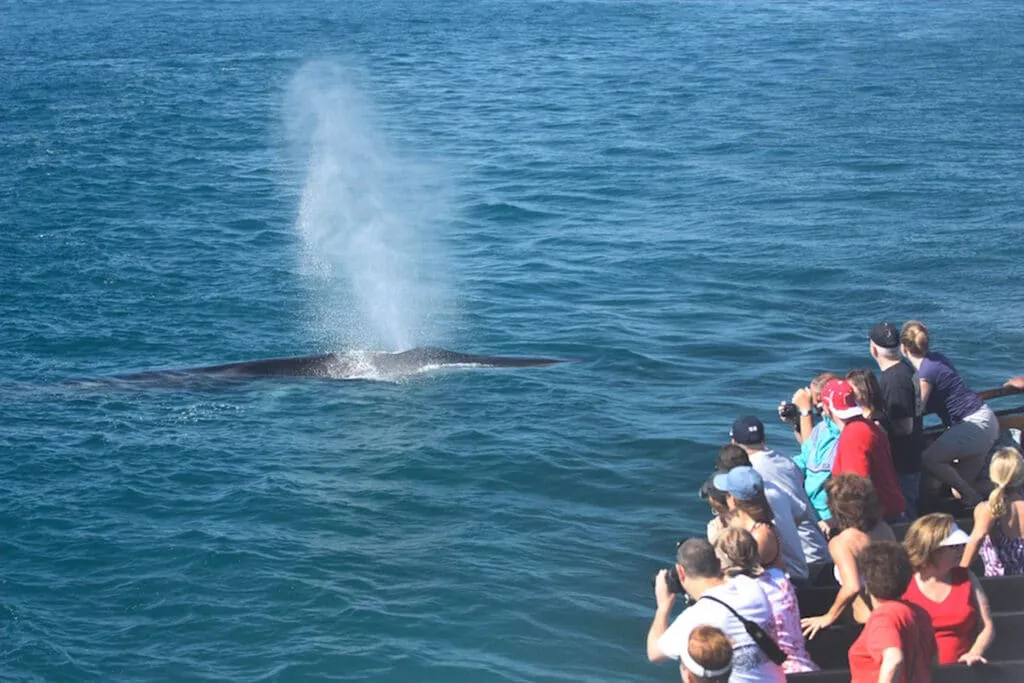
The Blow or Spout
When whales exhale warm air from their lungs through their blowhole into cooler ocean air, it creates a white-looking spout that can reach up to 15′ high. This is the easiest thing to see from land and is often mistaken for water.
The Tail (or Flukes)
When whales dive, they sometimes lift their tails above the ocean’s surface. The tail has two lobes, which are called flukes.
Knuckled Back and Footprint
After a whale surfaces to blow out air (which you may have seen), you may see its knuckled back rise and fall as it dives back into the water. Once it submerges, you’ll see a calm area of water called a footprint.
Breach and Splash
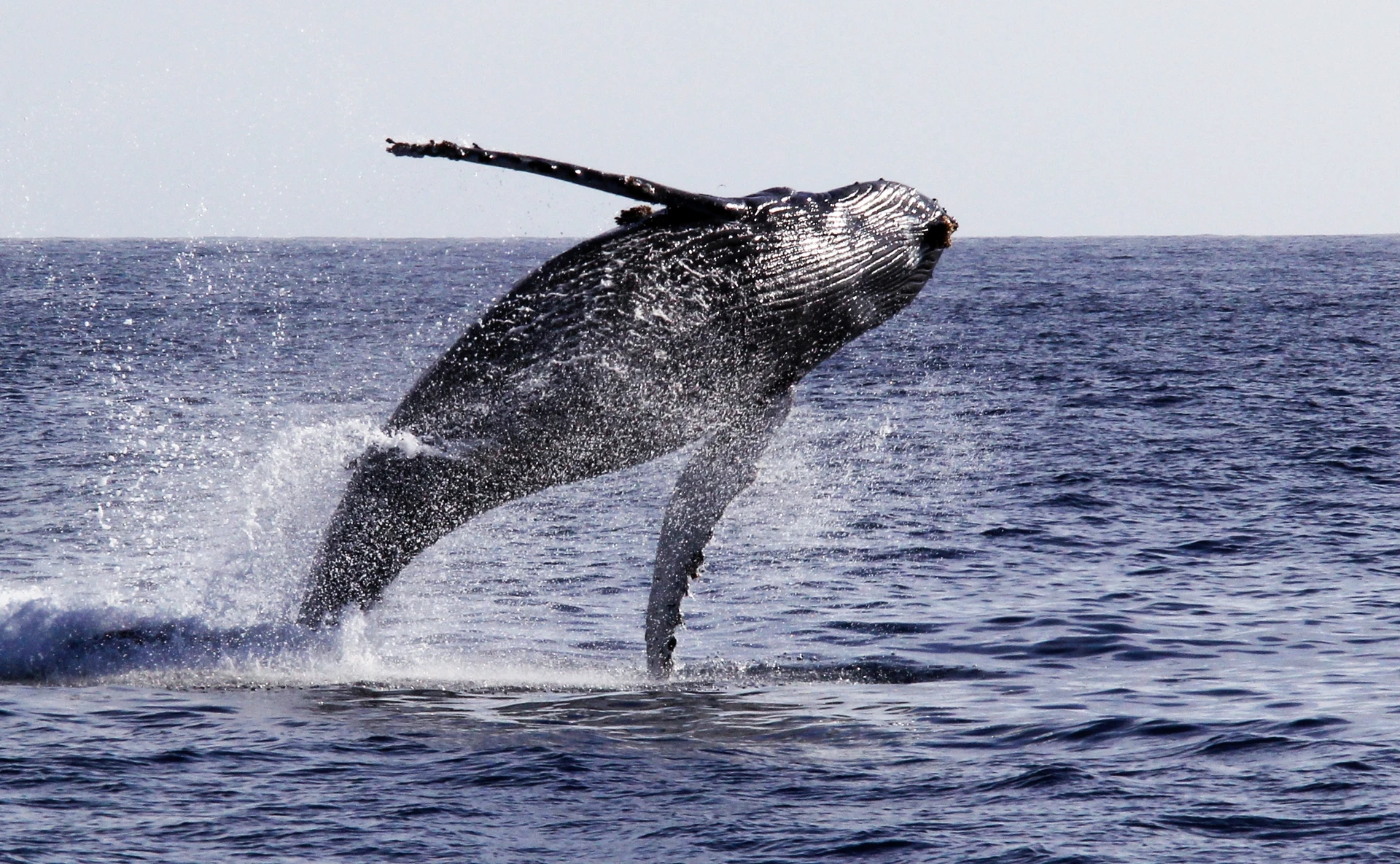
Humpback whales tend to breach more than other whales. It’s when they use their tails to propel nearly their entire bodies out of the water. And, of course, an enormous splash follows. Gray whales are known to breach, too.
Next, Look Ahead
If you see any of the above behaviors, where to look next depends on where you are in the migration season. Look south if it’s gray whale season and they’re heading to Mexico, for example.
More Things to Do in San Diego for Whale Lovers
If you’re crazy about whales, there are things to do in and around San Diego that you’ll definitely enjoy. At SeaWorld® San Diego, you can see orcas, beluga whales, and bottlenose dolphins up close, and there’s a huge array of exhibits featuring other marine animals, plus lots of great rides.
Birch Aquarium showcases the research of the Scripps Institution of Oceanography. It’s a perfect stop for marine life enthusiasts and budding oceanographers, or anyone who wants to enjoy a fun family day out. There are hands-on exhibits and more than 60 fish and invertebrate habitats.
FAQs About San Diego Whale Watching
Is it whale watching season in San Diego?
Yes, whale watching season in San Diego is technically year-round. However, the most popular time to go is between mid-December and April for gray whale sightings during their annual migration. The second popular season is in summer for blue whale sightings.
It’s lovely to be out on the water during the shoulder months because you can still see sea lions, birds, dolphins, a variety of other smaller-toothed and baleen whales, and other sea creatures.
What is the best whale watching tour in San Diego?
It depends on what kind of experience you want. Flagship Cruises and Events is the established family-owned choice with the longest history (since 1955). City Experiences is best for first-timers and motion-sensitive travelers, with naturalists from the San Diego Natural History Museum onboard. Next Level Sailing offers a unique sailing experience aboard the historic Yacht America with a no-seasickness guarantee. San Diego Whale Watch and Legacy Whale Watch both depart from Mission Bay, which is convenient if you are staying in Pacific Beach or Mission Bay. Everyday California offers an intimate kayak option during gray whale season (December to March). O’side Whales runs an intimate 6-passenger Zodiac from Oceanside Harbor, ideal for travelers staying in Carlsbad or anywhere in North County.
What is the best month for whale watching in California?
The best month for whale watching in California depends on where in the state you are. In San Diego, the best month is usually January because that is when most whales are spotted heading south to Baja California, Mexico. Also, pregnant females swim closer to shore when heading south and further offshore when heading north later in the season with their calves.
Where can I see whales in San Diego?
Your best chance of seeing whales in San Diego is on a tour that heads into the ocean. The guides know how to find whales and where they are most recently seen. Most tour companies mentioned on this list maintain a recent sightings list that you can check out to get an idea of what’s been seen near the time of your tour.
You can see whale spouts and rarely a whale breaching from places on land listed above, like Cabrillo National Monument and Torrey Pines State Natural Reserve.
What kind of whales are in San Diego?
You can see quite a few different whales in San Diego, including gray whales, blue whales, humpback whales, pilot whales, minke whales, and orcas. There was even a very rare beluga whale sighting off the San Diego coast not too long ago!
Have you taken one of the whale watching tours in San Diego? What species did you see?

Katie Dillon









Leave a Reply