

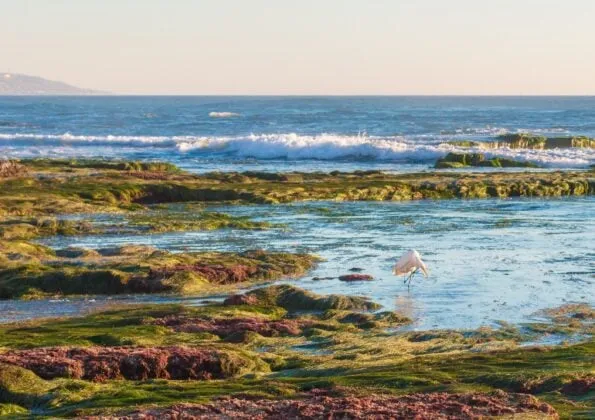



If you’re looking for the best tide pools, San Diego is an excellent contender. Going tide pooling is one of the free and fantastic things to do in San Diego in winter. San Diego tide pools are usually exposed between November and March when very low minus tides happen during daylight hours.
One of the many neat things about tide pooling in San Diego is that no two visits are ever the same. The animals that live in the tide pools move between habitats. For example, that starfish or sea anemone you saw last time may not be in the same place next time.
In this guide, you’ll discover some interesting facts about why these natural wonders are vital (It is also handy edutainment if you’ve chosen this winter activity from my list of best things to do in San Diego with kids). I’ll also share tips for where to find the best tide pools in San Diego, what to know before you go, the optimal times to go, the animals you might see, and much more.
Fun Facts for Your San Diego Tide Pool Visit
Before you set off to find unique tide pools with your family in San Diego, let’s learn a little bit more about what they are and just what you’ll discover.
What Are Tide Pools?
Tide pools form when water gets trapped during low tides, creating small pools that provide a natural habitat for unique marine life that we don’t usually see.
These pockets of water are found in rocky parts of the coast where the ocean meets the sand. Three tide pool depths are divided into zones that are each important to the ecosystem: the splash zone, the intertidal zone, and the subtidal zone.
The splash zone is where a few animals, like chitons, live because the tides rarely reach them. Splashes of water nourish these animals, and they can handle the salty residue as water evaporates. In contrast, the subtidal zone is always covered with water, with bottom-dwelling invertebrates and larger fish.
But for the sake of this article, we’ll focus on the rocky intertidal zone, which lies between the splash zone and the subtidal zone. Most people think of the pools that form here when they refer to tide pools. The lower the tides, the more California tide pool animals, including chitons, sea urchins, sea stars, and small fish, you’ll see in these delicate ecosystems.
How to Know When to Go
Knowing when to go tide pooling in San Diego or anywhere else is easy. All you need to do is check the San Diego tide chart. It will show tides measured in feet relative to the average water level.
Low tide is less than 1 foot. However, for the best tide pooling, you’re looking for negative tides (very low tides) or tides close to 0.
If you see a tide chart say -1 or lower, that’s the best time to go. Even if you can make it an hour or two before the lowest tide, you’ll have a blast and enjoy beautiful views of our rocky coastline.
What Makes California Tide Pool Animals So Unique
Twice in a 24-hour period, a whole new world is revealed on the rocky coastline, making it a fantastic place to explore, especially with kids. All you need to do to find fascinating wildlife is to turn over a few rocks carefully.
Some plants and animals can only be found in this dynamic habitat. To live in California’s tide pools, they must be tough enough to withstand extreme fluctuations.
During rainy days, a tide pool that’s usually salty may be flooded with fresh water. On hot days, the water in a tide pool can get quite warm. The water level in tide pools may drop significantly depending on the weather. Without the ocean’s protection, sea life becomes suddenly vulnerable to birds and other land-based predators.
San Diego Tide Pool Animals You Might See
Despite the unpredictable conditions, many incredible animals live in tide pools. In San Diego, CA, you might see:
- sea anemones
- barnacles
- baby fish (tide pools serve as hatcheries for some species)
- translucent ghost shrimp
- brittle stars
- sea stars
- brightly colored nudibranchs
- purple sea urchins
- hermit crabs
- limpets
- two-spot octopuses
- sea hares
- sea cucumbers
- small sea snails like periwinkle snails and black turban snails
- small rock crabs
- California mussels
Pick up a brochure about the tide pools and the types of sea creatures you’ll find. Seeing how many you can identify makes for a fun scavenger hunt with the kids.
10 Best Tide Pools in San Diego County (South to North)
- Coronado Beach Tide Pools
- Cabrillo National Monument Tide Pools, Point Loma (top pick)
- Sunset Cliffs Natural Park, Ocean Beach
- Ocean Beach Tide Pools
- Tourmaline Surfing Park, Pacific Beach
- False Point, La Jolla (Bird Rock)
- Shell Beach, La Jolla (Top pick in The Village because you can walk between other tide pool areas)
- Dike Rock, La Jolla (La Jolla Shores)
- Cardiff State Beach Tide Pools
- Swami’s State Beach, Encinitas
The above San Diego tide pools are listed from south to north, with a few of my favorites called out. I listed this way because people tend to want to see tide pools in San Diego near where they already are.
The two exceptions are the tide pools in Cabrillo and La Jolla. These are the two spots people travel to.
1. Coronado Beach tide Pools (In Front of Hotel del Coronado)
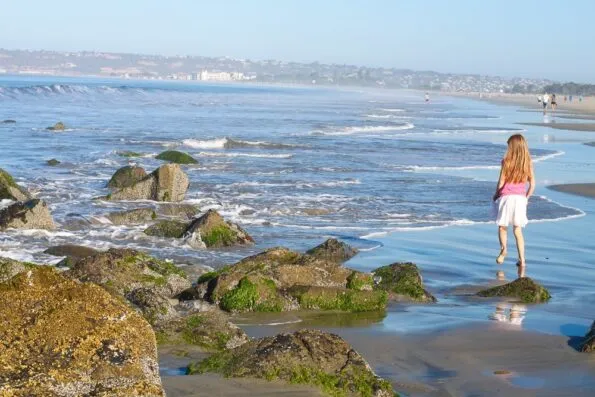
The best Coronado tide pools are right in front of the Hotel del Coronado. They are not big, but it’s a good choice for visiting San Diego tide pools with kids because you don’t have to wander far out onto the rocks to see marine life.
Plus, it’s worth pointing out that this beachfront San Diego resort is one of the most popular with readers. If you do want to book your stay here, you’ll want to do so in the late fall and winter, as these times of year present the best opportunities for tide pooling.
What you’ll see: You will definitely see anemones, barnacles, limpets, chitons, and likely some hermit crabs. If it’s a really low tide, then perhaps small fish and sea hares.
When I walk along the rocky shoreline here in the morning, I tend to find sand dollars and other pretty shells. If you’re lucky, you might also enjoy an enormous and ornate sandcastle creation by the Sandcastle Man.
How to get there: You can pay to park at the resort, whether you’re a hotel guest or not. Street parking is an option, but it is difficult to find. You’ll see a jetty in front of the hotel, which is popular for family and wedding photos. The tide pools are on the hotel side of the jetty.
Fun Facts
The SS Monte Carlo shipwreck is located just south of the hotel. If it’s a VERY low tide after an El Nino storm powerful enough to uncover the wreckage, you will be able to see what remains of this 1920s gambling ship.
2. Cabrillo National Monument Tide Pools, Point Loma (Top Pick)
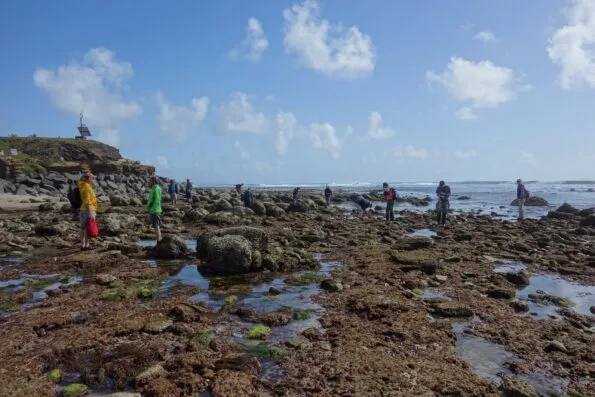
The Cabrillo tide pools are among the finest tide pools in San Diego and are only a short drive from the San Diego Zoo. The waters surrounding Cabrillo National Monument, a popular tourist attraction, host an incredible ecosystem of unique plants and diverse marine life. They are often referred to as the Point Loma tide pools, as this national park is situated in the Point Loma neighborhood.
The coast that hugs Cabrillo National Monument is home to protected and easily accessible rocky intertidal zones in Southern California. Remember, the word ‘intertidal’ refers to the ecosystem that sits between the high and low tides along the shore.
What you’ll see: The area closest to shore is home to invertebrates like periwinkle snails, lined shore crabs, acorn barnacles, troglodyte chitons, and various limpets.
The middle intertidal zone is the area that’s fully submerged during high tide and fully exposed during low tide. Creatures you’ll find here include California mussels, aggregating anemones, limpets, chitons, California sea hares, snails, crabs, fish, lobsters, and octopuses.
How to get there: The Cabrillo Monument tide pools are located at the bottom of the park. You’ll enter the park and pay the entrance fee. Next, go straight and just before the main parking lot, you’ll see signs to turn right into the tide pool area. The address is 1800 Cabrillo Memorial Dr., San Diego, CA 92106.
The drive down to the tide pools is beautiful and very picture-worthy. If you aren’t driving, ensure you’re on camera duty. The parking lot in this area isn’t very big and can fill up quickly. You can also use the bigger lot near the Visitor Center and walk down.
Note: Cell phone reception is very spotty at the Point Loma tides, so be sure to make arrangements beforehand if you’re getting a ride or need to coordinate with others. Remember that fourth graders receive free entry as part of the National Park Service’s Every Kid Outdoors initiative. Learn more about how to get the pass here.
Visit the Rest of Cabrillo National Monument
Don’t skip the rest of the park. After exploring the tide pools, head back uphill toward the Visitor Center. Take a photo in front of Juan Rodriguez Cabrillo (the Spanish Explorer credited with the discovery of California), admire views of San Diego Bay, and walk the hiking trails.
3. Sunset Cliffs Natural Park, Ocean Beach
Sunset Cliffs Natural Park lives up to its name as one of the best places in San Diego to watch a sunset. The beach below the park is also called Garbage Beach, but it’s popular for surfing and beachcombing.
Water fills the flat rock channels along the shoreline, revealing plenty of sea life at low tide. You’ll see a more rocky terrain on the north side of the stairs down to the beach to explore.
What you’ll see: Smaller limpets, crabs, fish, snails, and anemones.How to get there: The stairs to the beach are roughly where Ladera Street and Sunset Cliffs Boulevard meet. You’ll see plenty of street parking and a nearby dirt lot. Don’t scramble down the sandstone cliffs. There is erosion happening here. In fact, the street-level parts between Adair and Osprey streets are closed for safety reasons.
4. Ocean Beach Tide Pools
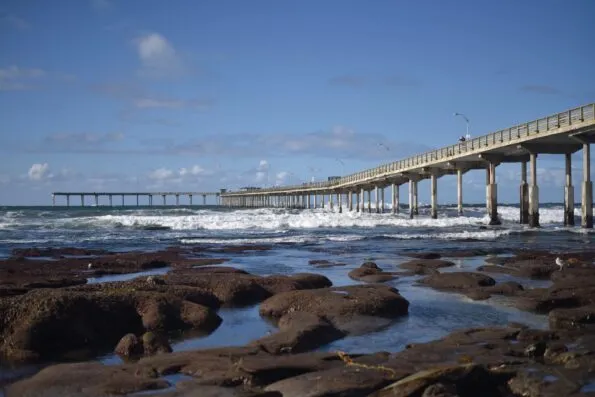
If you’re in the eclectic Ocean Beach neighborhood during low tides, head over to the pier, where you’ll see lots of low-lying sandstone rocks where lots of sea life lives.
This is one of the best tide-pool spots in San Diego for kids because the rocks are relatively flat, with shallow pools between them. You’ll still need to watch the kids and ensure they wear proper footwear to navigate slippery terrain.
What you’ll see: Sea anemones, barnacles and limpets, pretty sea grasses, hermit crabs, and some small snails.
How to get there: The OB Pier at the end of Newport Avenue. You can’t miss it. A small (usually full) parking lot is north of the pier. So, your best bet is to look out for metered street parking or one of the several paid lots.
5. Tourmaline Surfing Park Tide Pools, Pacific Beach
Though mainly known as a popular San Diego surfing spot, Tourmaline Surf Park in Pacific Beach is also home to some extensive tide pools. They’re located just a few minutes’ walk north of the surfing area, and are tucked away in the soft sandstone and on top of a larger boulder field.
You’ll find plenty of tube snails, barnacles, and anemones here, as they do well with the slow water flows. The rocks are typically covered with very slippery algae, so shoes with a good grip are a must.
What you’ll see: Sea snails, red thatched barnacles, aggregating and solitary anemones, limpets, and tube snails near the low water line. The little ones will enjoy looking out for hermit crabs here and other shelled creatures as well.
How to get there: Take La Jolla Blvd. until you reach the Tourmaline St. intersection. Then, turn onto Tourmaline toward the beach and into the parking lot. Park in the lot (or on La Jolla Blvd. if the lot is full) and start walking north until you reach a large boulder field with some smaller rock outcroppings. Start looking for snails in the sand before you reach the rocks. They like to hide.
Carry a Plastic Bag
We’ve participated in organized beach clean-ups here because trash and microtrash tends to wash up onto this beach. If you see any, please pick it up if it’s safe to do so. Litter is harmful to sea life.
6. False Point, Bird Rock, La Jolla
You’ll find these Bird Rock tide pools at the bottom of a relatively steep staircase, a mile or so north of Tourmaline. This area is rockier than most, but the abundance of pebbles and shallow spots makes for an excellent tide-pooling experience.
Additionally, the area is rarely crowded due to its somewhat secluded location, which creates a much more tranquil environment for exploration. The ocean sunset views are incredible here, so if you’re going later in the day, be sure to stick around for a burst of color and an excellent photo op. You need to be very, very careful if you’re taking kids to this hidden gem because the rocks are slippery, and it’s easy to fall.
What you’ll see: You can see sea creatures like hermit crabs, sea anemones, brittle stars, sea urchins, and occasionally lobsters.
How to get there: There is street access from Linda Way and La Jolla Blvd. intersection below Sea Ridge Drive (you’ll see access signs just to the left of 341 Sea Ridge Drive). The ramp and stairs take you directly down to the boulder and tide pool area, but it gets rocky very quickly. The large rocks could be challenging to navigate and climb down unless it’s extremely low tide. Be sure to wear shoes with a good grip and practice extra caution in this area.
7. Shell Beach Tide Pools, La Jolla
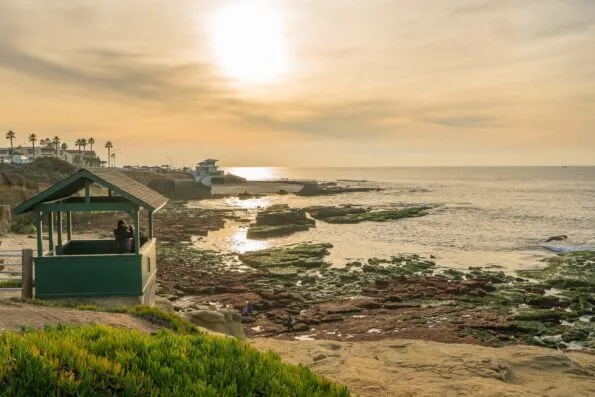
This little La Jolla beach is an excellent place to check out beautiful tide pools. On a good day, you’ll be able to see some pretty shells and colorful wildlife. However, the key here is to come at very low tide.
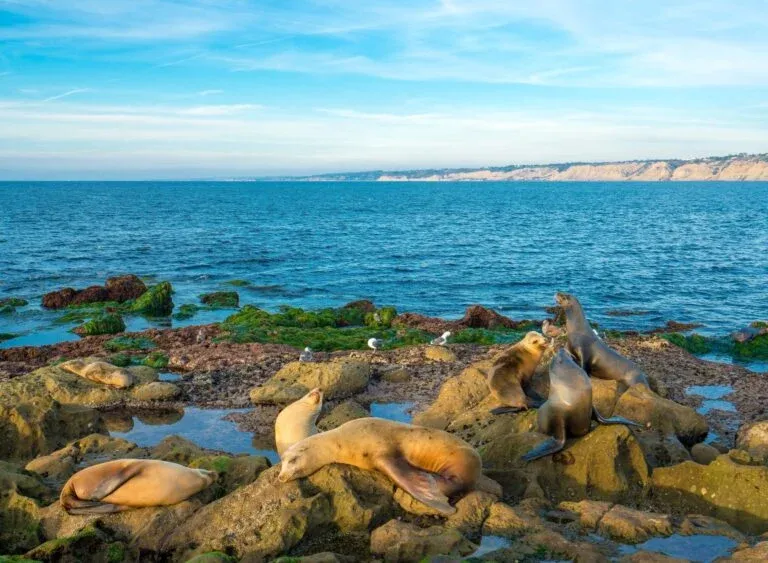
A fun aspect of the tide pools here is Seal Rock Reserve, a rocky island just offshore that is protected and reserved for the La Jolla seals and sea lions. Keep an eye out for them, as they’re often swimming around or sunning themselves on the rock. If you want to make a day of it, pack a picnic lunch and enjoy it under the shade of the green hut just above Shell Beach (a belvedere). This hut dates back many years and is a great spot to watch the waves.
What you’ll see: True to its name, you will see plenty of seashells of all sizes, which means you may also spot hermit crabs, seagrasses, anemones, and more.
How to get there: Shell Beach tide pools lie at the southern end of Ellen Browning Scripps Park in La Jolla, at the bottom of a small cement stairway. Look for the green hut and walk down the stairs to the left. “Shell Beach” will be engraved on the cement above it.
Why It’s a Top Pick — Lots of Nearby Tide Pool Spots
If it’s a minus tide, La Jolla tide pools will also appear all along the Coast Blvd. boardwalk north and south of Shell Beach. Start at La Jolla Cove and then walk to Shell Beach. Next, keep walking south to the Children’s Pool, where the harbor seals hang out. Behind the lifeguard station, there is South Casa Beach, another tide pool spot. You can even keep walking south to Hospital Point, where there are even more tide pools.
Read my complete list of La Jolla tide pools for more information.
8. Dike Rock, La Jolla Shores Beach
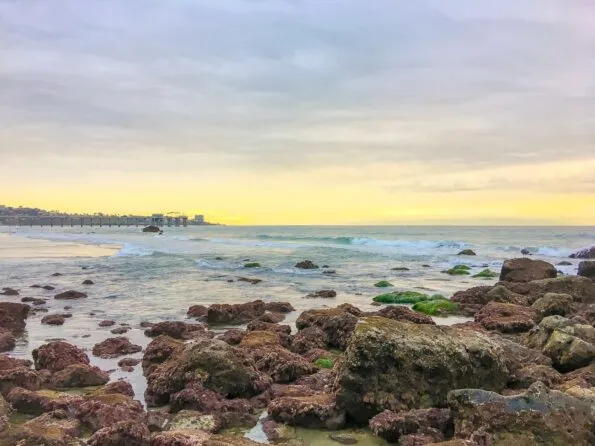
A favorite of UCSD biology students, this La Jolla tide pool is essentially a rocky area just north of Scripps Pier. The beach’s name refers to a slab of volcanic rock that has forced its way through a significant gap in the sedimentary rocks, which you’ll see once you get down there. This area is protected as part of the La Jolla Underwater Park marine reserve.
For an in-depth experience at La Jolla tide pools, sign up for a Tidepooling Adventure Tour by Birch Aquarium (highly recommend). Their trained naturalists will be able to point out various wildlife and answer any questions you have. We have taken this tour at the Dike Rock tide pools, and it’s great outdoor fun for the whole family.
What you’ll see: Dike Rock tide pools have rare starfish, hermit crabs, sea anemones, and octopuses during minus tides.
How to get there: Start at La Jolla Shores Beach (8200 Camino Del Oro, La Jolla, CA 92037) and walk north along the shoreline. Pass Scripps Pier, then pass another rocky area until you reach the dike, which juts out slightly.
9. Cardiff State Beach
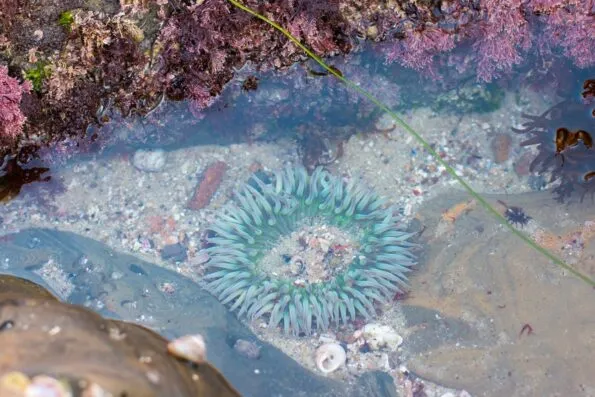
Another top tide pool in San Diego is Cardiff State Beach. These beautiful tide pools are located about thirty minutes north of La Jolla in Cardiff-by-the-Sea. This small, quiet little seaside community that you’d miss if you blink is nestled right between Encinitas and Solana Beach.
The tide pools here comprise 45-million-year-old sedimentary rocks containing embedded clam fossils, a fascinating and rare sight you won’t see at other local tide pools. They are located at the south end of the beach, at a spot called Seaside Beach. At low tides, the flat rocks that make up Table Top Reef become exposed, which is super cool to walk on. Find them south of Lifeguard Tower 10.
What you’ll see: Besides fossils, look for starfish and sea cucumbers in addition to the usual residents: hermit crabs, limpets, chiton, and other mollusks.
How to get there: The Cardiff tide pools are located by the bluffs at the south end of the parking lot at Cardiff State Beach. Drive along the Pacific Coast Highway past Solana Beach and just north of Lomas Santa Fe Drive. You’ll see a sign labeled “Cardiff Beach” and a large parking lot. Before you walk down to the rocky area, you’ll find a small information board with illustrations of tide-pool life.
10. Swami’s State Beach, Encinitas
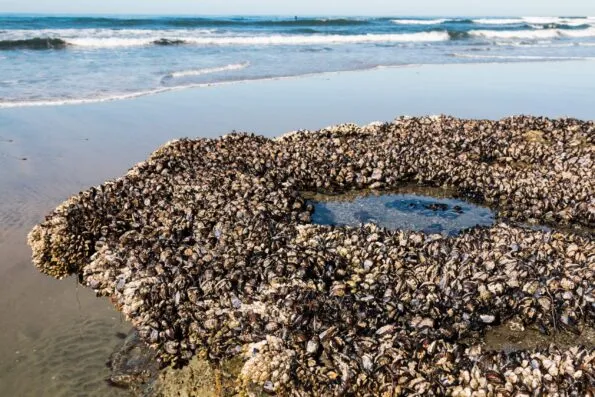
This Encinitas beach has long been a haven for surfers and is known for its excellent surf break. Swami’s State Beach is located just north of Cardiff. It has a substantial reef formation with fascinating marine life that becomes visible during low and minus tides.
You’ll find oyster fossils here. If you’re in the mood for a walk, you can head toward the San Elijo Lagoon and even the South Carlsbad Beach jetty from Swami’s. It’s in an excellent central location.
What you’ll see: Octopuses, crabs, brittle stars, starfish, sea hares, and sea cucumbers.
How to get there: From Cardiff, continue north along the Pacific Coast Highway until you see Encinitas’s southernmost part. The beach parking lot will be on your left just before you reach downtown. If you see the white domes of the Self-Realization Fellowship, you’ve gone too far. There are no visible signs, but look for the carved wooden tiki head statue on the grass.
Bonus: Year-Round Tide Pools at Birch Aquarium
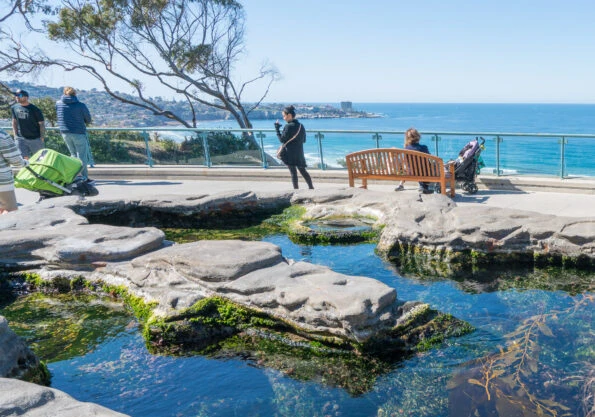
You can see San Diego tide pools year-round at Birch Aquarium at Scripps, the public outreach arm for the world-famous Scripps Institution of Oceanography. When people ask me where to see tide pools during the summer, I send them here.
Tide Pool Plaza is situated on the back patio, which also offers panoramic views of the Pacific Ocean over La Jolla Shores Beach. Under docents’ supervision, you can safely touch some of the sea life, like a sea anemone or hermit crab. Be sure to use the nearby hand washing stations to wash off lotions or hand sanitizer before and after touching.
What you’ll see: Rare California abalone live in these tide pools, which are difficult to see in the wild. There are also usually anemones, sea stars, hermit crabs, and sea hares. You’ll want to check the daily schedule for tide pool feedings. Also, they typically lead fun tide-pooling tours during the winter season.
How to get there: The address is 2300 Expedition Way, La Jolla, CA 92037. The aquarium has a lot with free three-hour parking for guests. It does fill up, so arrive early. Otherwise, you can find street parking nearby, but be careful, as some areas are marked for UC San Diego permit holders.
Things to Know Before Visiting San Diego’s Best Tide Pools
Taking precautions is the only way to have a safe and enjoyable experience.
- You can safely touch any tide pool animals if you’re extremely careful and gentle with them. Rinse your hands first to ensure that all hand sanitizer and any other substances that might harm delicate creatures are washed off.
- Wear close-toed shoes with a good grip, as the tide pool rocks can get slippery when wet. Also, wear clothing and footwear that can get wet, as it’s likely that you’ll get soaked. Flip-flops are a terrible idea because they provide insufficient traction. But always remember to tread lightly.
- Your shoes should be sturdy enough to withstand some rock scrambling. It’s also a good idea to bring along a towel, a change of dry clothes, or extra shoes.
- Sunscreen is a good idea, even during a San Diego winter.
- There are two high and low tides a day, and it is always best to go at low tide or minus tide. Check the local paper, obtain a tide table from a dive/surf shop or lifeguard station, or check a San Diego tide table online to determine the best time for tide pooling.
- If this is your first tide pooling experience, you should bring a tide pool guidebook. It’s great to observe the unique creatures you find, but it can be even more exciting to learn exactly what the animals are and how they got there. And don’t forget to bring a camera, tide pools and their residents can be very colorful.
- Be aware of the incoming tide and ocean waves at all times, especially if you are with younger children.
- Collecting any natural item or living organism is strictly prohibited at all San Diego tide pools. Respect the wildlife and take care when walking around the intertidal zone.
Frequently Asked Questions About Tide Pools in San Diego
These are some of the questions I receive about going tide pooling in San Diego and elsewhere in California.
Why Is Winter the Best Time for Tide Pooling
During late fall and winter, when the tide ebbs in the mid-afternoon or evening, water levels are significantly lower than at other times of the year. This exposes more of the fascinating intertidal zone that you can see in daylight.
These low tides happen at night throughout the rest of the year, which obviously makes visibility an issue. It’s not impossible to see some of the high intertidal zones exposed during the summer months, but it’s pretty rare. You might see an occasional sea anemone or limpet, but not much else.
What Are the Best Tide Pool Spots for Kids?
The best San Diego tide pools for kids are ones where they can walk on sand or flat rocks to avoid tripping and slipping. These are two easy things to do when navigating this kind of beach terrain. You’ll want to avoid rocks covered with seagrass or algae. Kid-friendly tide pools I like are also conveniently located near other family activities that you can pair with a visit.
With the above in mind, I think that the La Jolla tide pools are best for kids. You’ll find amazing tide pools all within walking distance of each other along Coast Boulevard between La Jolla Cove and Hospital Point, including Shell Beach. In this area, parents can find suitable areas to explore for their children’s ages and abilities. Plus, families can catch a glimpse of our seals and sea lions along the way, one of my top things to do in La Jolla.
My second choice is Cabrillo National Monument because the area to explore is quite large. Plus, you can combine your tide pool visit with a chance to learn about the discovery of California in the city’s only national park. The mild hiking trails are also fun to explore.
Where Are the Best Tide Pools in California?
There are tide pools up and down the California coast, though, of course, I’m biased and think that some of the best tide pooling in Southern California can be found right here in San Diego (Cabrillo National Monument and La Jolla are recognized as top places for this in the state).
Multiple spots along the Laguna Beach coastline are popular for tide pooling.
What Is the Best Time to Visit Tide Pools?
The best time to visit tide pools is during low tide, in the late fall and winter. On the California coast, there are two low tides each day, and their timing varies from day to day.
A minus tide, indicated on a tide chart by a minus sign, is optimal because California tide pools will be the most exposed.
Are There Tide Pools at SeaWorld San Diego?
There are no authentic tide pools at SeaWorld San Diego, but you can visit the Aquaria Touch Pool exhibit to touch and learn about starfish in a simulated tide pool setting. SeaWorld also has an Explorer’s Reef where you can touch harmless reef sharks and California round rays. The Animal Care Ambassadors supervise all of these pools.
If you’re interested in visiting SeaWorld San Diego, you can grab a discounted ticket here.
Can I See San Diego Tide Pools in the Summer?
It’s possible to go to the tidal pools in San Diego during the summer months, but you’ll need to do some planning. If there is a low tide, it’s likely very early in the morning and only on a handful of days during sunlight. For example, you can usually catch low tides on a few days during June and July around 7 a.m. Check the San Diego tide charts.
If you aren’t an early bird, go to Birch Aquarium at Scripps to see their interactive pool filled with marine creatures. Sure, they are human-made, but they do look exactly like the ones at the beach and house the same animals. Plus, you have a docent there to answer your questions.
Will I See Starfish?
Several different types of starfish live in California tide pools. The most common starfish you’ll encounter in San Diego tide pools will be the ochre sea star, which comes in colors like orange, brown, and purple. Look for them near mussel and barnacle beds.
The colorful bat star is easy to recognize because its arms are connected by a web. The brownish brittle star has five skinny arms that it uses to move around, and can often be found under rocks.
Giant sea stars are much bigger than most other sea stars in the intertidal zone, growing up to two feet in diameter, but are seen less frequently because they like to live in the deepest areas. The same is true for pink sea stars. I hope you get lucky and visit one of these amazing creatures because they are rare to spot lately.
Why Are Tide Pools Important?
Tide pools are an important ecological habitat on the California coast because they provide a safe haven for many small creatures and an important food source for larger ones. They also serve as an important barrier that slows down water flow to keep our cliffs from eroding.
It’s important to examine animals in tide pools gently and respectfully, but even our behaviors at home impact their ecosystem. Remember that storm drains around San Diego wash everything from trash to fertilizer into the ocean.
Are Tide Pools Dangerous?
Tide pools can be dangerous to humans if you do not walk carefully around them. Algae and seagrasses that line some of the rocks can be slippery and hide pools you might not see. You can slip, twist your ankle, and fall rather easily if you are not careful.
Tide pools can be dangerous for the sea life that lives in them if humans behave recklessly while exploring them. Don’t litter, watch where you are walking, and keep in mind that shells, rocks, sticks, and grasses might be someone’s home.
How Do Tide Pools Form?
You might think that tide pools only form when the tide goes out and exposes depressions in the rocky ground, but new tide pools can also form when big waves are driven further up beaches by storms or high winds.
These waves push sand and stones ahead of them, creating mounds that run parallel to the shore, and the water that rushes over these mounds is trapped. Whenever water gets trapped in a low area, a tide pool may form.
Suppose ocean activity is significant enough to change the shape of a beach or other coastal areas. In that case, the resulting pool can become a permanent feature, and wildlife will eventually populate the pool.
Which San Diego tide pools do you like to visit?







The photos are beautiful and this is a great resource for tide pooling novices and experts. Let’s go!
I will be staying at the Hotel Del Coronado the first weekend in Feb. According to the hotel they have tide pooling, which I have never done with our eight year old daughter.
Can you comment on the quality of tide pooling around that hotel or should we seek one of the destinations you noted in your article in Nov?
Hi Ed. Whether or not you’ll be able to tide pool anywhere in San Diego depends on how low the tides are during your stay. The Hotel Del Coronado has a little area right in front of the hotel where you will be able to see hermit crabs, sea anemones and other sea life. I would start there. I regret that it doesn’t look that low during the first weekend in Feb. Usually, the tide pools expose themselves when the tides are below 1 or minus. You can see the low points during the day on this calendar – http://ca.usharbors.com/monthly-tides/California-South%20Coast/San%20Diego/2017-02
Either way, you’ll enjoy your stay at the Del!
Amazing information on tide pools! It’s July and I think we’re goig to try seeing the tide pools but now I want to come back and see the difference in winter too! Thank you!
What a fabulous resource! We are headed that way in July and my daughter is itching to see some tide pools. I will be keeping this article handy for reference. Thanks so much.